
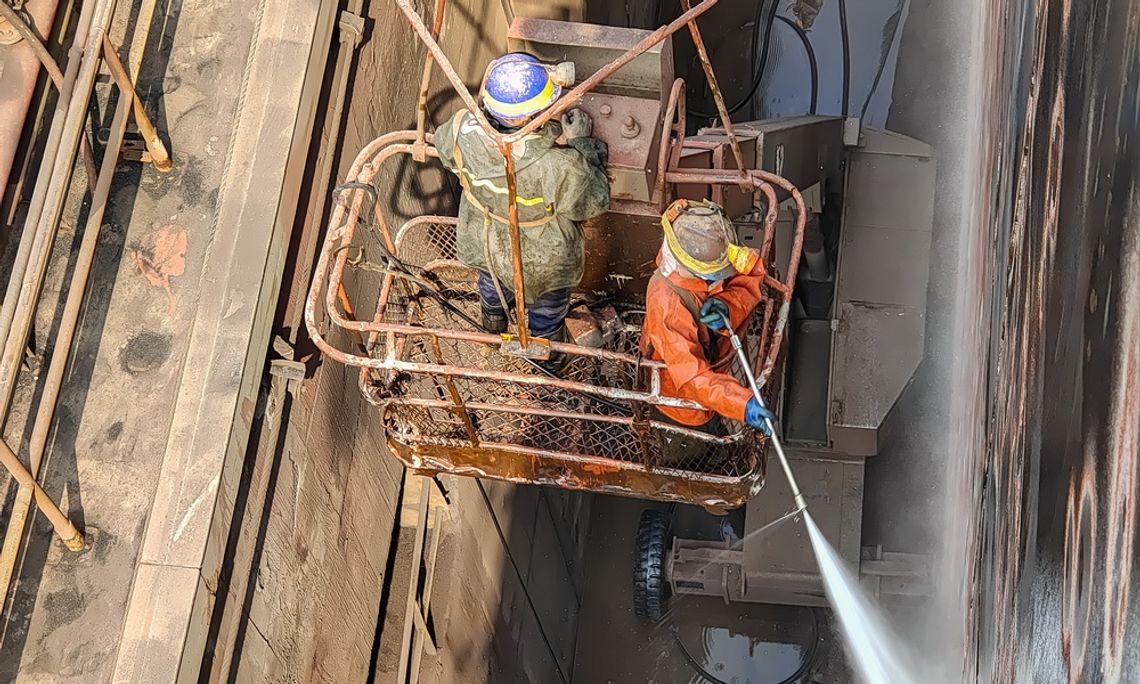
Industrial surfaces collect paint, scale, grease, and bonded residue during daily operations. Hydroblasting uses pressurized water to break those bonds while limiting dust across the work area. Understanding which surfaces you can clean using hydroblasting ensures that crews won’t damage these materials during the cleaning process.
1. Steel
As high-pressure water hits a steel surface, rust scale fractures along its weakest points, allowing it to lift away in sheets or granular fragments rather than smearing across the metal. The material is strong enough to remain intact after removing the compromised outer layer.
Pitted areas and weld seams are naturally exposed, which can be beneficial when preparing the material for recoating or inspection. In many cases, this exposure helps identify fatigue points or inconsistencies that were previously hidden under scale.
2. Aluminum
Although aluminum is softer than steel, it distributes impact energy across its surface instead of concentrating force in a single point. This decreases the risk of deep surface damage.
Additionally, aluminum naturally forms a thin oxide layer that establishes a protective barrier. Therefore, it resists light corrosion and remain stable when exposed to pressurized water. This combination of softness and resilience allows the metal to withstand hydroblasting when operators carefully manage the machine’s pressure.
3. Concrete
Concrete’s porous, mineral-rich structure makes it highly responsive to high-pressure water cleaning. Water penetrates surface pores and loosens weak laitance, coatings, and weathered cement paste without relying on abrasive media. This interaction allows the material’s natural microcracks and variable density to guide the cleaning action, exposing sound aggregate while leaving structurally intact sections in place.
When comparing sandblasting and hydroblasting, engineers evaluate how each method interacts with concrete’s tendency to shed fine particles and how much surface erosion each process introduces. Hydroblasting also performs well in repair zones because water naturally follows existing fissures and voids, clearing debris from irregular edges and preparing the substrate for restoration.
4. Stucco
Stucco presents a textured, cement-based surface that bonds only lightly to its underlying structure. The water penetrates the porous finish and lifts embedded dirt and failing coatings. However, it’s important to note that extremely high water pressure can erode the surface and expose the base layer. The concentrated impact puts aged or patched sections at risk of separating, making it essential to use the appropriate water pressure during cleaning.
5. Composites
Composite surfaces respond to hydroblasting based largely on the type of reinforcement and the resin system holding the structure together. For example, high-density fiberglass-reinforced plastic (FRP) with a well-cured epoxy or vinyl ester matrix tends to perform well because of the tightly encapsulated fibers. The water is able to disperse across the surface rather than concentrate in one weak point.
Carbon fiber-reinforced polymers (CFRP) with epoxy resin systems are also among the more resilient composites. Their layered structure and strong fiber-to-resin bonding help maintain integrity when exposed to moderate hydroblasting pressure.
Thermoplastic composites, such as those made with PEEK or high-density polyethylene (HDPE) matrices, also show strong resistance. Because these materials are not as brittle as some thermoset systems, they can absorb and redistribute the force of the water stream more effectively.
Clean Surfaces Efficiently With Hydroblasting
Understanding which surfaces you can clean using hydroblasting gives crews the ability to refresh industrial materials efficiently. By ensuring that the technique matches the substrate, removing buildup will be straightforward.
Comment
Comments